Find where ai can make the biggest difference to GROW your business.
AI ideas are everywhere. The harder question is which AI opportunities can really make a difference to grow your business.
The AI Opportunity Workshop brings together what matters most to your business, what customers and employees really need, and what is realistically possible with AI.
After one focused workshop day, you leave with a prioritised shortlist of AI opportunities, the rationale behind the choices and a clear view of what to focus on next.
ai activity is everywhere. business impact is harder to see.
It is Monday morning.
The management team is discussing AI again.
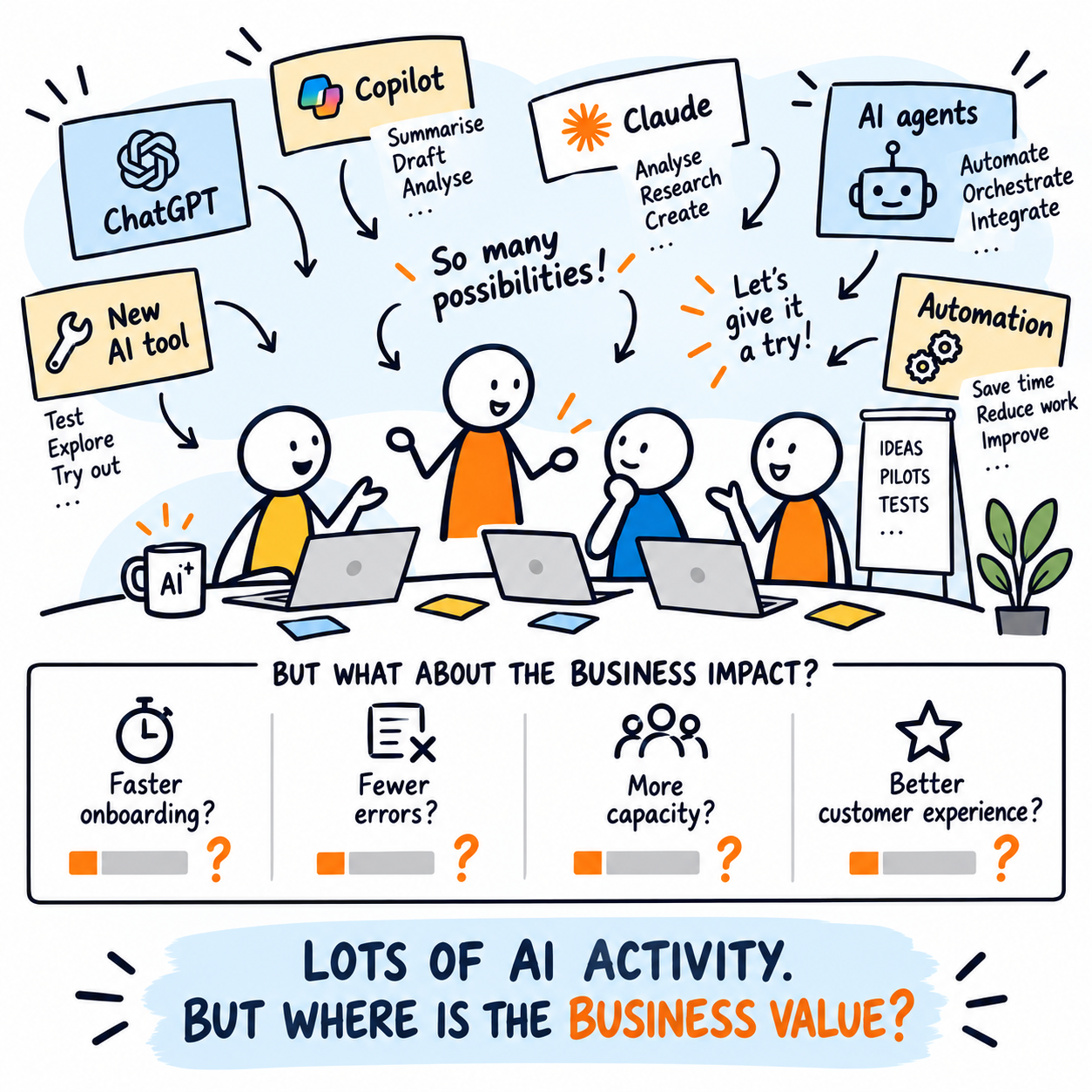
Marketing is experimenting with Copilot. Customer Service has started a Claude pilot. IT is exploring AI agents. Someone from Sales has found another tool that could save the team hours of work.
There is certainly no shortage of activity.
But when the conversation turns to business results, things become less clear.
Are we actually improving the way our business works? Are customers or employees noticing a meaningful difference?
AI may already be saving people time. Someone prepares a meeting faster. Another person summarises a document in minutes.
But zoom out from the individual task and the same waiting, rework, handovers and fragmented systems may still be there.
People are getting faster. But the organisation is not necessarily getting better.
McKinsey’s 2026 global AI survey illustrates that gap. While 80% of respondents say AI has improved individual productivity, 37% report a positive contribution to enterprise EBIT.
The challenge is not creating more AI activity. It is finding where AI can make the biggest difference to the business.
The Technology-First Trap keeps AI on the surface
Someone sees an impressive AI demo.
The question quickly becomes: “Could we use this in our organisation?”
A tool is selected. A pilot starts. A team is asked to find some use cases.
Only later does someone ask:
“What problem are we actually trying to solve?”
That is the Technology-First Trap: starting with what AI can do and then searching for somewhere to apply it.
Take a customer application that takes ten days to process. AI reduces one 30-minute document-reading task to five minutes. Useful.
But what if the application then waits a day for approval? Or missing information creates rework.
You have made one task dramatically faster.
But have you improved the overall outcome?
This is why the better starting point isn’t AI.
It is work worth improving.
the expensive questions come later
Starting from what the AI technology can do does not remove the difficult questions. It simply moves them further down the road.
You may spend weeks developing a promising AI idea before discovering that the problem is not important enough, the right data is not available, the solution does not fit the way people actually work, or the expected business value is too small.
By then, you have already invested time, money and scarce capacity.
And there is another cost. Too many pilots that go nowhere make it harder to maintain focus and confidence around AI.
The earlier you ask the difficult questions, the easier and less expensive it is to change direction.
Start with what needs to improve, not with AI
Instead of asking:
“Where can we use AI?”
start with three more useful questions:
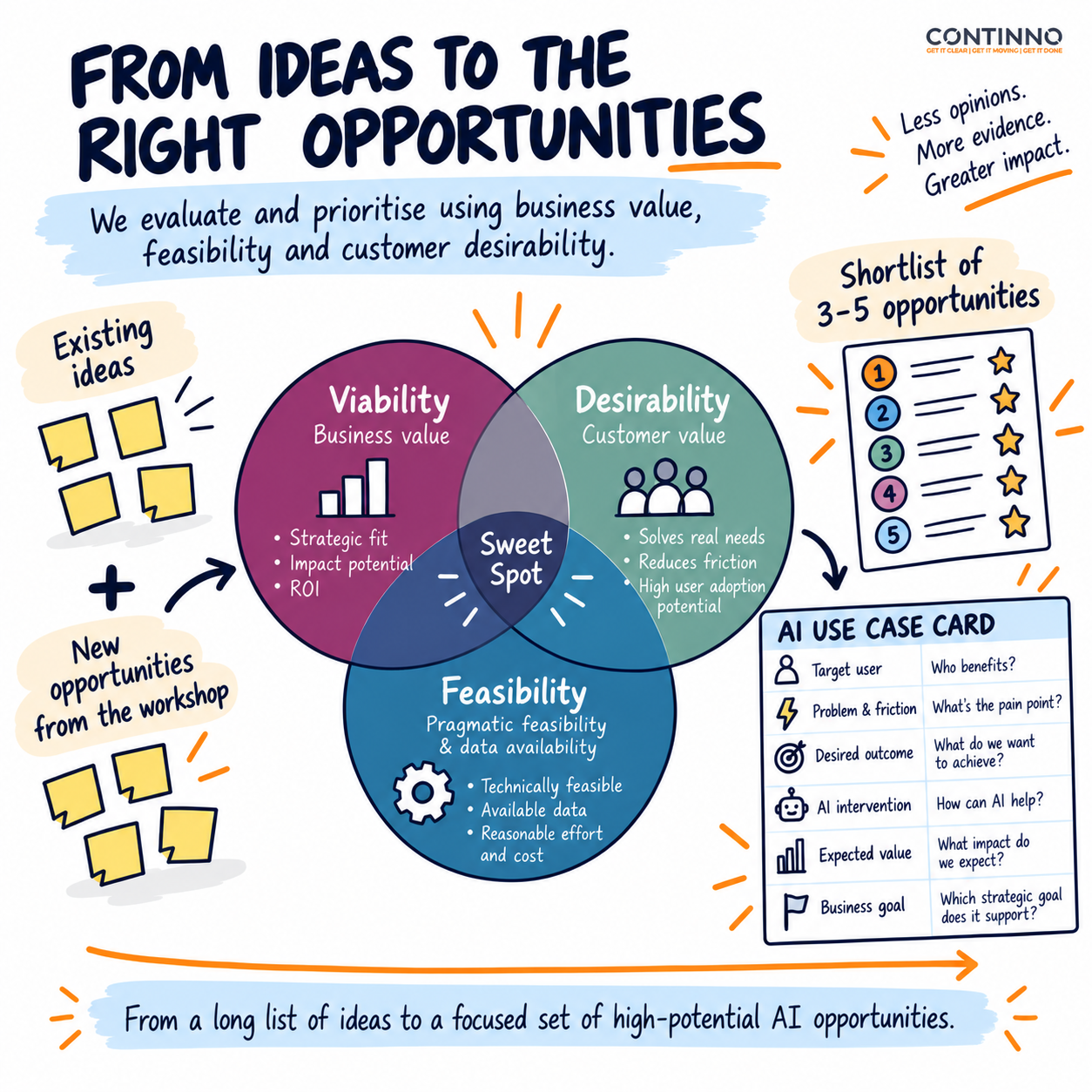
1. What matters most to the business (viability)?
Where do we need to improve performance, growth, quality, speed or capacity?
2. What do customers and employees really need (desirability)?
Where are the problems, friction and unmet needs that are worth solving?
3. What is realistically possible with AI (feasibility)?
What can we achieve given the technology, data, workflow, risk and adoption constraints?
The strongest AI opportunities sit where these three perspectives come together.
what is an ai opportunity workshop?
An AI Opportunity Workshop is a structured way to identify and prioritise where AI can make the biggest difference to grow your business.
During the workshop, we:
1. Bring together the AI ideas
Start with the ideas, pilots and requests already on the table.
2. Connect them to your business objectives
Focus on the outcomes, goals and KPIs that matter most.
3. Understand people and their needs
Explore who is affected, what they need and which problems are worth solving.
4. Look at how the work happens today
Find the friction, delays, repetitive work and handovers where AI could make a difference.
5. Prioritise the strongest AI opportunities
Compare business value, customer or employee value, feasibility, data readiness, risk and adoption to identify the opportunities with the strongest potential to make a difference.
The result
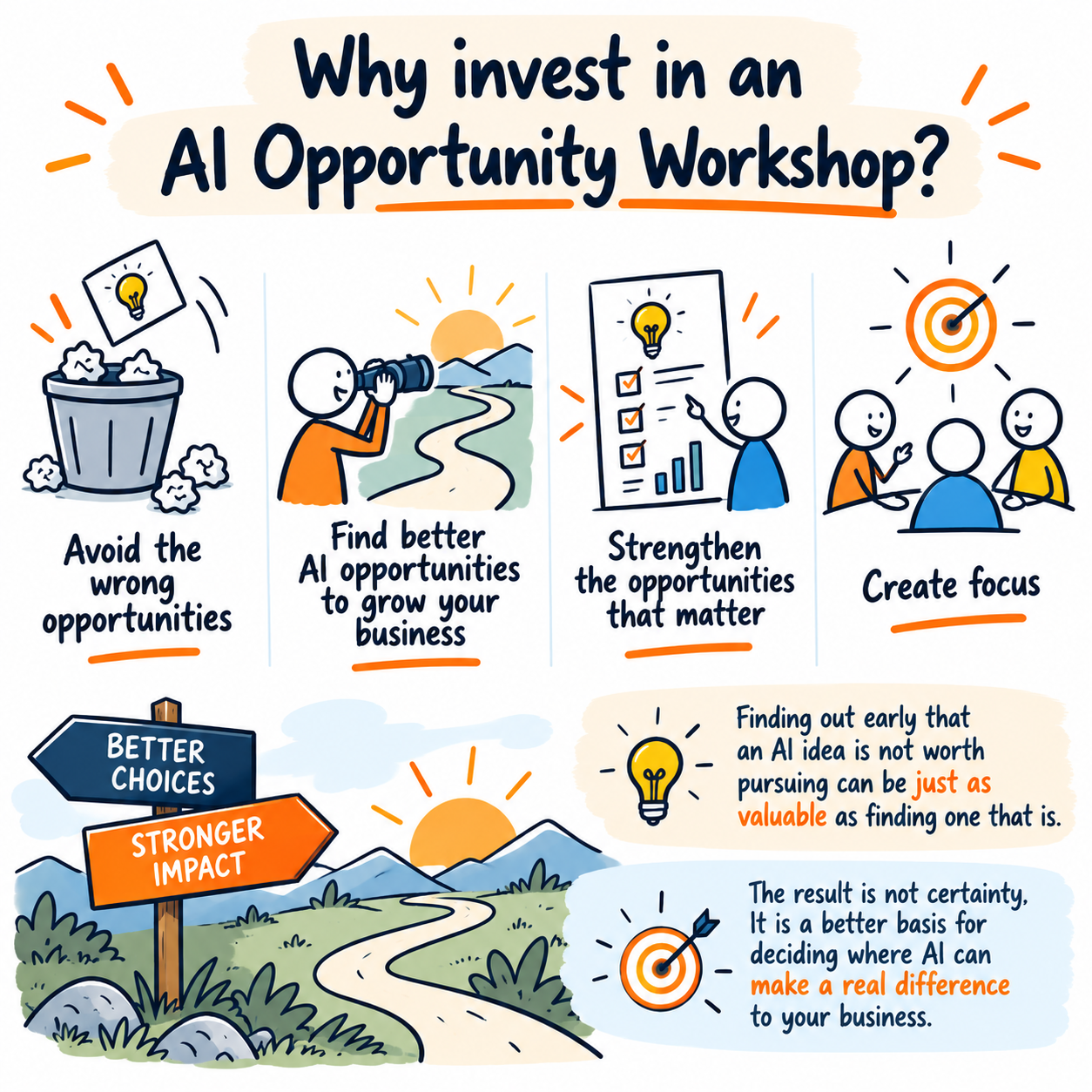
After one focused workshop day, you leave with a prioritised shortlist of 3 to 5 AI opportunities, the rationale behind the choices and a clear view of what to focus on next.
The aim is to make better informed choices about what to further validate, what to park and what to stop.
AI Opportunity workshop at a glance
WHAT YOU ACHIEVE
- Focus on the AI-opportunities with the strongest potential for your specific situation.
- Shared view and collaboration across Business and Data & Tech.
- Better informed investment choices.
WHAT YOU LEAVE WITH
- A prioritised shortlist of 3-5 AI opportunities.
- The rationale behind the choices.
- A clear next step for each opportunity.
IDEAL FOR
- Organisations and teams with plenty of AI ideas but lacking focus.
- Leaders who want to leverage AI to grow their business and want to make the most of their AI investment.
- Strengthening the collaboration between Business and Data & Tech to make choices together.
LESS SUITABLE IF
- You already know exactly which AI opportunity you want to implement.
- You mainly need technical implementation support
- There is no clear business scope or sponsor.
what this looks like in practice
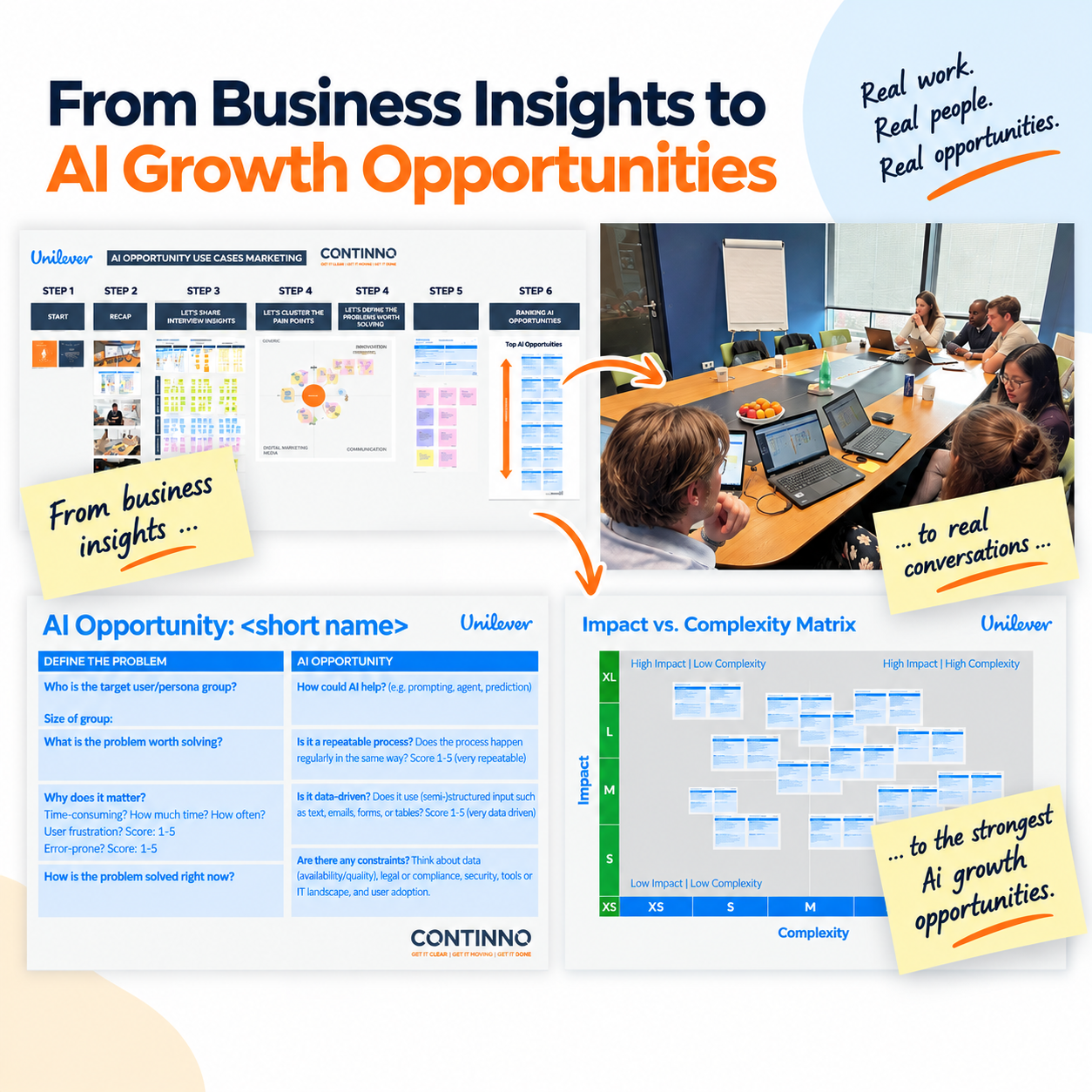
At Unilever Foods Europe, we started by looking at the work, not the technology.
Internal AI champions interviewed employees to understand where repetitive, data driven and coordination heavy work was taking unnecessary time and effort.
This surfaced a range of potential AI opportunities. Together with colleagues from Business and Data & Tech, we then looked at which ones were worth taking further.
We asked three questions:
1. Does it address a real customer or employee need?
2. Can it create meaningful business value?
3. Is it realistic from a technology and data perspective?
The strongest opportunities moved forward for further validation.
The goal was not to find more AI ideas. It was to identify the opportunities with the strongest potential to make a difference to the business, and consciously decide what not to pursue.
Smart preparation makes the day count
Before the workshop, we agree on the scope, the business challenge, the workshop team and what we need to make good decisions.
We bring together existing AI ideas, relevant goals and KPIs, and available customer, employee or process insights. Where useful, selected customers, employees or users are interviewed to better understand their everyday work and needs.
I provide the structure, templates and guidance to make this preparation practical.
The aim is simple: arrive at the workshop with enough evidence to spend the day making choices, not collecting information.
Preparation typically starts with a short kick off around one week before the workshop.
who should be in the room?
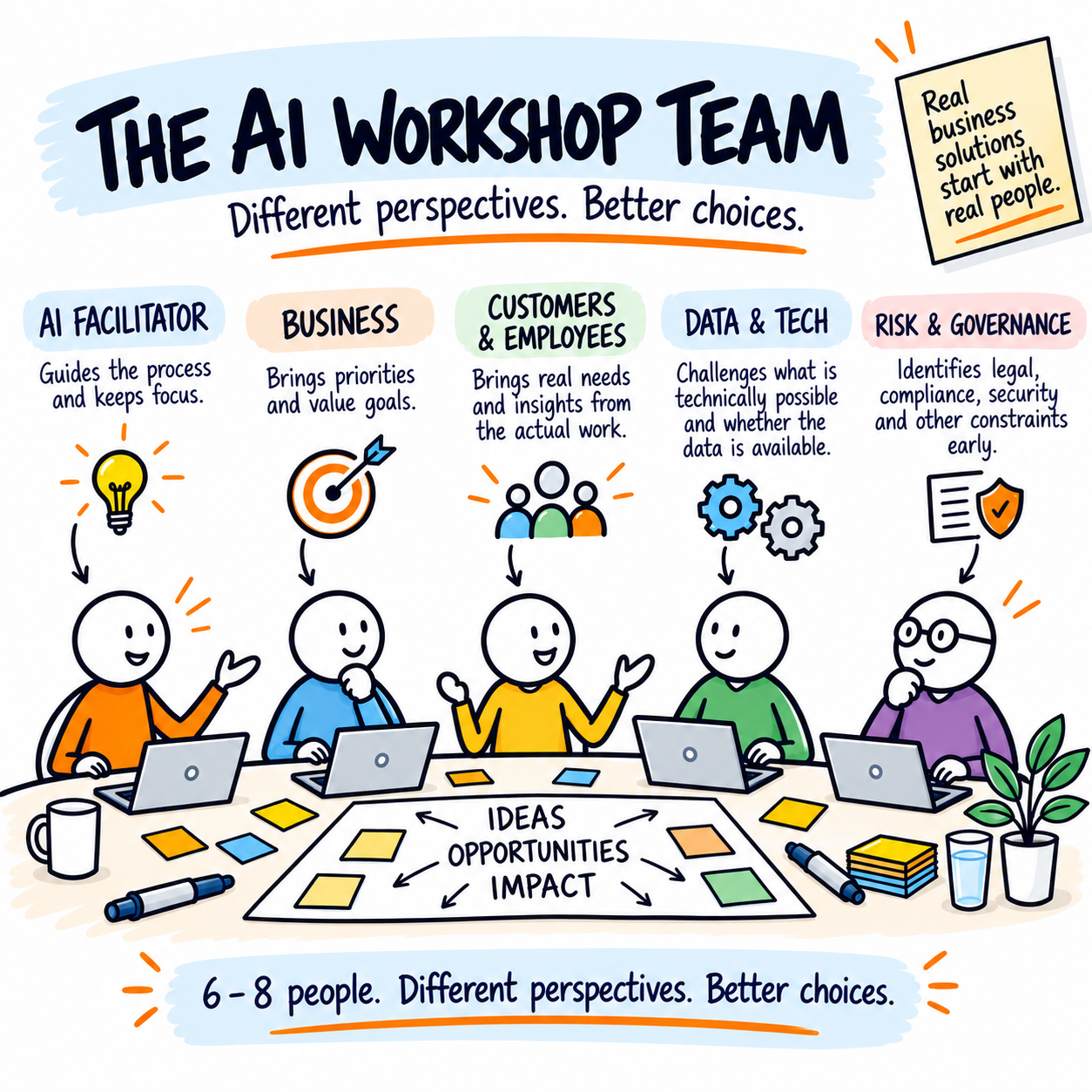
The strongest AI opportunities rarely sit within one function. You need different perspectives to understand what matters, what people need and what is realistically possible.
The workshop typically brings together 6 to 8 people covering four perspectives:
Business
Someone who understands the priorities, outcomes and where value needs to be created.
People and work
People who understand the customer, employee and the work as it actually happens today.
Data and technology
People who can challenge what is technically possible and whether the required data is available.
Risk and governance
Where relevant, someone who can identify legal, compliance, security or other constraints early.
A decision maker or sponsor should also be involved so that choices made during the workshop connect to real business priorities and can move forward afterwards.
Frequently asked questions
Where should we start looking for AI use cases in our business?
Start with business outcomes and recurring workflow friction rather than tools. Look for waiting, rework, repetitive information processing, manual handovers and decisions that could be better supported. Then assess whether AI can materially improve the outcome and whether the new way of working can be integrated into existing processes and systems.
What happens in an AI Opportunity Workshop?
In a one-day AI Opportunity Workshop, a cross-functional team of 6–8 people from business and IT moves from existing AI ideas to business goals, real customer or employee problems, workflow context and prioritised AI use cases. The aim is not to generate a long list of ideas. It is to create a shortlist of opportunities with enough business value, feasibility and organisational fit to justify further investment and focused validation.
What do you need to run an AI Opportunity Workshop?
Start with a clearly defined business area or challenge and a sponsor who can connect the work to relevant business goals.
The process typically starts 3–4 weeks before the workshop. Together with the sponsor, we define the scope, agree on the desired outcomes and bring together a cross-functional team of 6–8 people with knowledge of the business, customers or employees, day-to-day work, technology and data.
We then hold one week before the workshop day a 1 hour project kick-off with the team to align on the challenge, explain the approach and start the preparation. This includes gathering existing AI ideas and relevant business and workflow insights. I also conduct 1–2 interviews to better understand the context and where the real friction sits.
This means we arrive at the workshop with enough insight to spend the day making choices rather than collecting information.
How do you stop AI pilots from going nowhere?
Start every pilot with a real business problem, a clear baseline, a measurable outcome and an accountable owner. Test the solution in the real workflow with the people who will actually use it.
Most importantly, agree upfront how you will judge whether the pilot is successful. At the end, use what you have learned to make a clear decision: scale, adapt or stop.
How much does an AI Opportunity Workshop cost?
An AI Opportunity Workshop starts from €5,500 excluding VAT and travel.
The workshop is part of a 3–4 week process, allowing enough time to prepare properly and make the workshop day count.
This includes sponsor alignment, a team kick-off, 1–2 stakeholder interviews, analysis and preparation, a full-day workshop for 6–8 participants, documentation of the results and a follow-up conversation with the sponsor.
The exact investment depends on the scope and the amount of research needed. More extensive research, additional workshops or support with experiments can be added separately.
your facilitator
Jens Broetzmann is the founder of CONTINNO and has more than 25 years of experience helping organisations and teams turn change into practical progress. He combines systems thinking, Agile, Lean, Design Thinking and behavioural change principles to create approaches that fit the context rather than forcing a methodology.

bring one AI challenge.
Ready to find where AI can make the biggest difference to your business?
Maybe you already have a long list of AI ideas. Or you’re still figuring out where AI could create real value.
Let’s get to know each other and talk about what you’d like to achieve.
In 30 minutes, we’ll explore what’s going on, what’s getting in the way and what could help you move forward.
No preparation needed. And we can talk in English, Dutch or German.

+ 31 – 6 53432423
jens.broetzmann@continno.com
‘s-Hertogenbosch, the Netherlands
Understand your situation
We look at what you would like to improve.
Explore options
We explore where AI could make the biggest difference.
Leave with clarity
You leave with a clearer view of your challenge and what to do next.