Organisational Change: Small Habits Make It Stick
Big plans can create direction. They do not, by themselves, change an organisation. Organisational change becomes real when people do something differently in everyday work and the surrounding system makes that new behaviour easier to sustain.
That is the practical challenge I see again and again after more than 25 years working with organisations and teams: what will actually be different on Monday morning?
Organisational change starts when daily behaviour changes.
The simplest definition of organisational change is a sustained shift in how people make decisions, collaborate and get work done. A new strategy, operating model or transformation roadmap may describe the destination, but it is not yet the change.
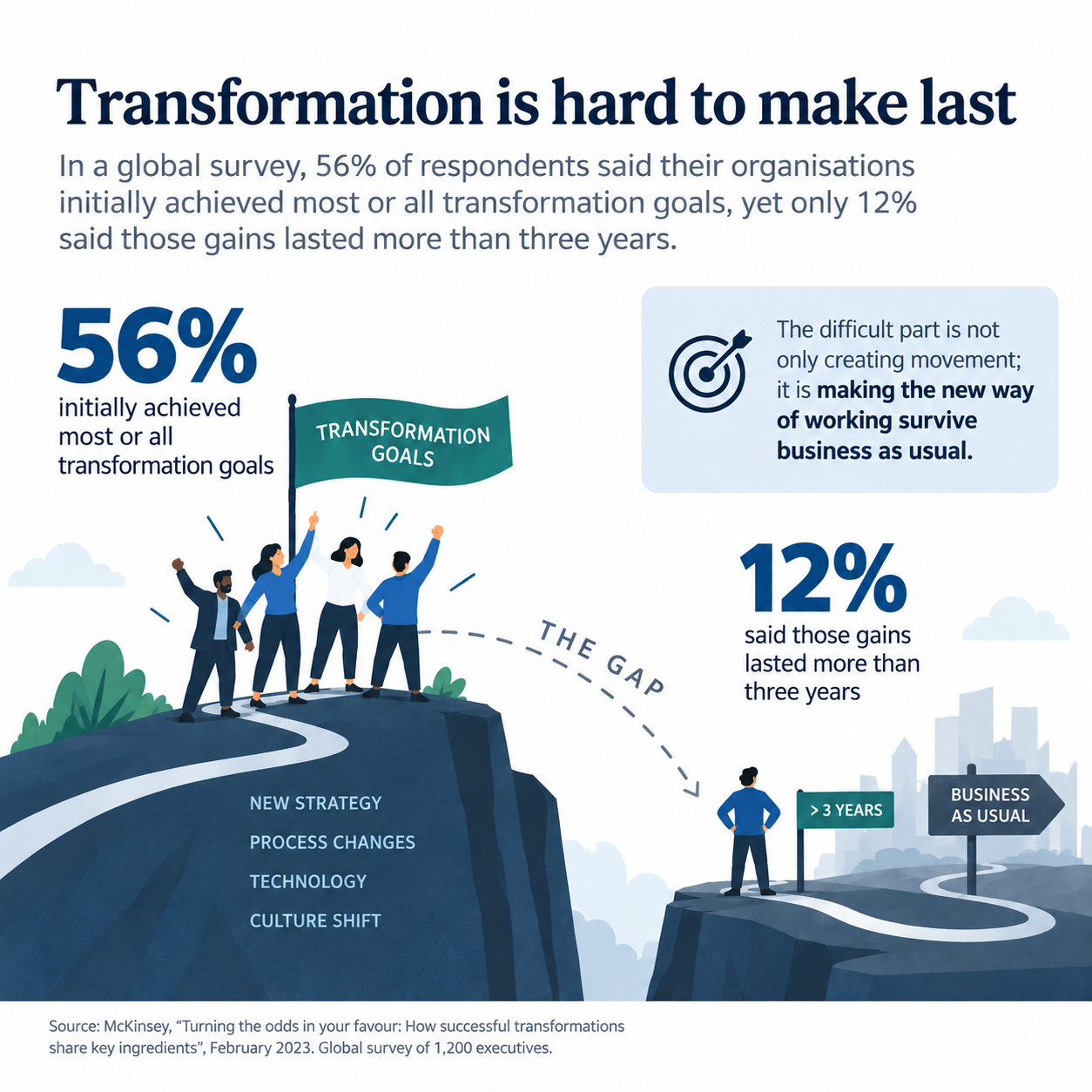
McKinsey’s transformation research illustrates the gap. In a global survey, 56% of respondents said their organisations initially achieved most or all transformation goals, yet only 12% said those gains lasted more than three years. The difficult part is not only creating movement; it is making the new way of working survive business as usual.
A practical example: an organisation wants to Increase its “organisational agility”. This sounds sensible, but nobody can do organisational agility at 10:30 on Tuesday morning. People can review priorities every two weeks, make dependencies visible earlier, stop lower-value work, or move decisions closer to the people doing the work. Those are behaviours.
This is also how I approach building stronger teams: translate ambition into a small number of visible behaviours that people can practise, discuss and improve.
The system determines whether new behaviour will stick.
Behaviour does not happen in a vacuum. People may understand the new direction and genuinely want to change, but priorities, incentives, governance, workload, decision rights or leadership behaviour can still pull them back to the old way.
This is where behavioural change and systems thinking meet. Ben Tiggelaar’s De Ladder translates change into three practical levels: goal, behaviour and support. The COM-B model makes a similar point from behavioural science: behaviour depends on capability, opportunity and motivation. In organisations, “opportunity” is often the system around the person.
Imagine a team that agrees every Monday on its three most important priorities. On Tuesday, five senior stakeholders arrive with urgent requests. On Wednesday, the manager adds another project. On Thursday, all twelve original priorities still have to be delivered. The prioritisation habit will not fail because the team lacks motivation. The surrounding system is making the old behaviour more logical.
That is why improving organisation flow and cross-team alignment matters: the answer is not always to ask people to collaborate harder; sometimes priorities, dependencies or decision mechanisms need to change.
A useful system check:
- What outcome are we actually trying to improve?
- What do people need to do differently in observable terms?
- What currently makes that behaviour difficult?
- Which process, meeting, target, incentive or decision rule reinforces the old behaviour?
- What can leaders change in the environment to make the new behaviour easier?
Small experiments make organisational change easier to learn.
Treat change as a hypothesis, not as a finished design. Agile, Lean Startup and Design Thinking all point to the same practical principle: understand the real problem, test assumptions early, learn from feedback and adapt before scaling.
BCG’s 2024 research with 127 companies found that 66% described their agile transformations as successful, but only 53% both achieved their transformation targets and created lasting change in culture and ways of working. Adopting practices is not the same as improving outcomes.
In practice, I prefer to make the first step deliberately small. If twelve priorities are creating noise, do not immediately launch a productivity programme. Try one behaviour for four weeks: every Monday, agree the three outcomes that matter most and make every new request compete with those three.
The same logic applies to creating more business impact with AI: instead of discussing twenty AI opportunities, improve one recurring workflow, measure what changes, learn and then decide what to scale.
A five-step change experiment:
1. Get clear: define the outcome that should improve.
2. Make it behavioural: describe what people will actually do differently.
3. Check the system: identify what could block or reinforce the new behaviour.
4. Test small: run the change in real work for a short, defined period.
5. Learn and adapt: review evidence, keep what works and change what does not.
The goal is to build the organisation’s own change capability.
The strongest outcome of a transformation is not dependence on a change programme or consultant. It is an organisation that becomes better at noticing friction, testing improvements, learning quickly and adapting its own ways of working.
This is why ownership matters. When change is designed elsewhere and rolled out to teams, people easily become recipients. When teams help diagnose the problem, shape the experiment and review the result, they build capability while improving the work.
For example, a leadership team can prescribe a new cross-functional process. Or it can set the outcome and boundaries, let the people closest to the work test a better handover, and review the result after four weeks. The second approach still needs leadership, but it creates learning and ownership at the same time.
My preferred sequence is simple: Get it clear. Get it moving. Get it done. Then evaluate, learn and improve. The aim is not constant change for its own sake. It is the capability to adapt when the work, customer or context requires it.
A regular rhythm turns experiments into lasting change.
A one-off workshop can create insight, but insight fades when everyday work takes over. Lasting organisational change needs a rhythm in which people repeatedly review what they intended to change, what actually happened and what they will adjust next.
Deloitte’s 2026 Global Human Capital Trends research found that only 27% of leaders believe their organisations manage change effectively. A third of workers reported experiencing more than 15 major changes in the previous year. Deloitte argues for moving from episodic change management towards continuous adaptability embedded in everyday work.
I see the same pattern in practice. A quarterly alignment session is useful only if teams use the priorities afterwards. A retrospective creates value only if an agreed improvement appears in the next cycle. An AI pilot matters only if someone reviews whether it made the work better.
Weekly question
Weekly What matters most now?
Practical Example
Agree the top three outcomes and surface blockers.
Monthly question
What is helping or getting in the way?
Practical Example
Review behaviour, dependencies and system friction.
Quarterly question
What should we continue, stop or change?
Practical Example
Quarterly What should we continue, stop or change? Reset priorities and adapt the next 90 days.
Common mistakes that make change harder:
Starting with a solution before understanding the real friction.
Using abstract ambitions without defining observable behaviour.
Adding change activities on top of already overloaded work.
Training people while leaving incentives, priorities and decision rights untouched.
Rolling out a large solution before testing whether it works in practice.
Declaring success after implementation instead of checking whether results last.
Frequently asked questions
Why do organisational change initiatives fail?
Many change initiatives lose momentum because strategy is not translated into daily behaviour, or because the surrounding system still rewards the old way of working. Research also shows that sustaining gains is harder than achieving them initially. Successful change therefore combines clear outcomes, concrete behaviour, supportive conditions, feedback and regular adaptation.
How do you make organisational change stick?
Make the desired behaviour specific, remove barriers in the work environment, start with a small real-world test and review progress at a fixed rhythm. The goal is to embed the new behaviour in normal processes, decisions and leadership routines so that it no longer depends on the original change programme.
Are small habits enough to transform an organisation?
No. Small habits are useful because they turn ambition into repeatable behaviour, but behaviour alone is not enough. If priorities, incentives, governance, workload or leadership behaviour contradict the new habit, the old pattern will return. Lasting change requires both behavioural change and changes to the system around it.
What is the role of leaders in successful organisational change?
Leaders create direction and the conditions for change. They clarify what matters, model the expected behaviour, remove conflicting priorities and make space for teams to learn. Their job is not to solve every problem themselves, but to make the new way of working possible and reinforce it through everyday decisions.
How is this different from traditional change management?
Traditional change management is often organised around a defined programme, communication and implementation. A more adaptive approach treats change as continuous learning: understand the system, make behaviour concrete, test in real work, gather feedback and adjust. This is especially useful when the solution cannot be fully designed in advance.
Change becomes real on Monday morning.
Big ambition still matters. But the real test is whether people can work differently tomorrow and whether the organisation helps that behaviour survive.
Want to identify the smallest change that could create meaningful movement in your organisation? Book a 30-minute conversation with Continno.
About the author
Jens Broetzmann is the founder of Continno and has more than 25 years of experience helping organisations and teams turn change into practical progress. He combines systems thinking, Agile, Lean, Design Thinking and behavioural change principles to create approaches that fit the context rather than forcing a methodology.
Let’s talk about what’s next.
You know where you want to go.
Let’s figure it out together how to get there.
+ 31 – 6 53432423
jens.broetzmann@continno.com
‘s-Hertogenbosch
Get it clear
We discuss what’s getting in the way.
Get it moving
We explore options that could make the biggest difference.
Get it done
You leave with a practical next step.