Developing a self-organising team starts with clarity
“Jens, would you take another look at our team with us?” That question came from a former client a few weeks ago. There was no crisis. Quite the opposite. The team was made up of experienced people who worked well together and cared about what they did. But something was getting in the way. They wanted to grow further as a self-organising team. More responsibility within the team. Less dependency on the Product Owner, Scrum Master and Team Lead.
In practice, this turns out to be harder than it sounds. When do you give a team space? When do you need to provide direction? And when is a team ready to take something on themselves?
More self-organisation sounds easier than it is
My first thought wasn’t: what training can we give them? It was: let’s first understand what is actually happening. Because developing a self-organising team, for me, isn’t about implementing a new model or simply handing more responsibilities to the team.
First, you need to understand where the team is today. So we started with a few simple questions:
- Where are we now?
- What does self-organisation mean to us?
- Where do we want to take more responsibility?
- What is holding us back?
The conversation that followed was at least as important as the solutions we came up with afterwards.
A self-organising team needs more than freedom
One of the key insights is that self-organisation isn’t mainly about giving people more freedom. It is just as much about clarity.
Clarity about expectations. About roles. About who takes responsibility for what. And about what people need from each other to actually do that.
This doesn’t just apply to the team. The roles of the Team Lead, Product Owner and Scrum Master also change when a team starts taking more responsibility.
When do you give people space? When do you help? When do you provide direction? And when should you simply do nothing?
So more self-organisation doesn’t mean that leaders should simply let go.
It means becoming clear together about which responsibilities the team can and wants to take on, and then creating the space to actually do so.

Make the next step small and practical
Once we had that clarity, we could get very practical. No new organisational model. No big transformation programme. Just concrete agreements the team could start using the next day.
That is an important principle for me in team development. The ambition can be big, but the next step doesn’t have to be.
If you want to understand where your own team stands, start with four questions:
- What are we already good at as a team and want to protect?
- Where could we take more responsibility ourselves?
- What is stopping us from doing that today?
- What do we need from each other and from our leaders to take the next step?
You don’t need to have all the answers straight away.
The conversation itself will often tell you a lot.
How self-organising is your team?
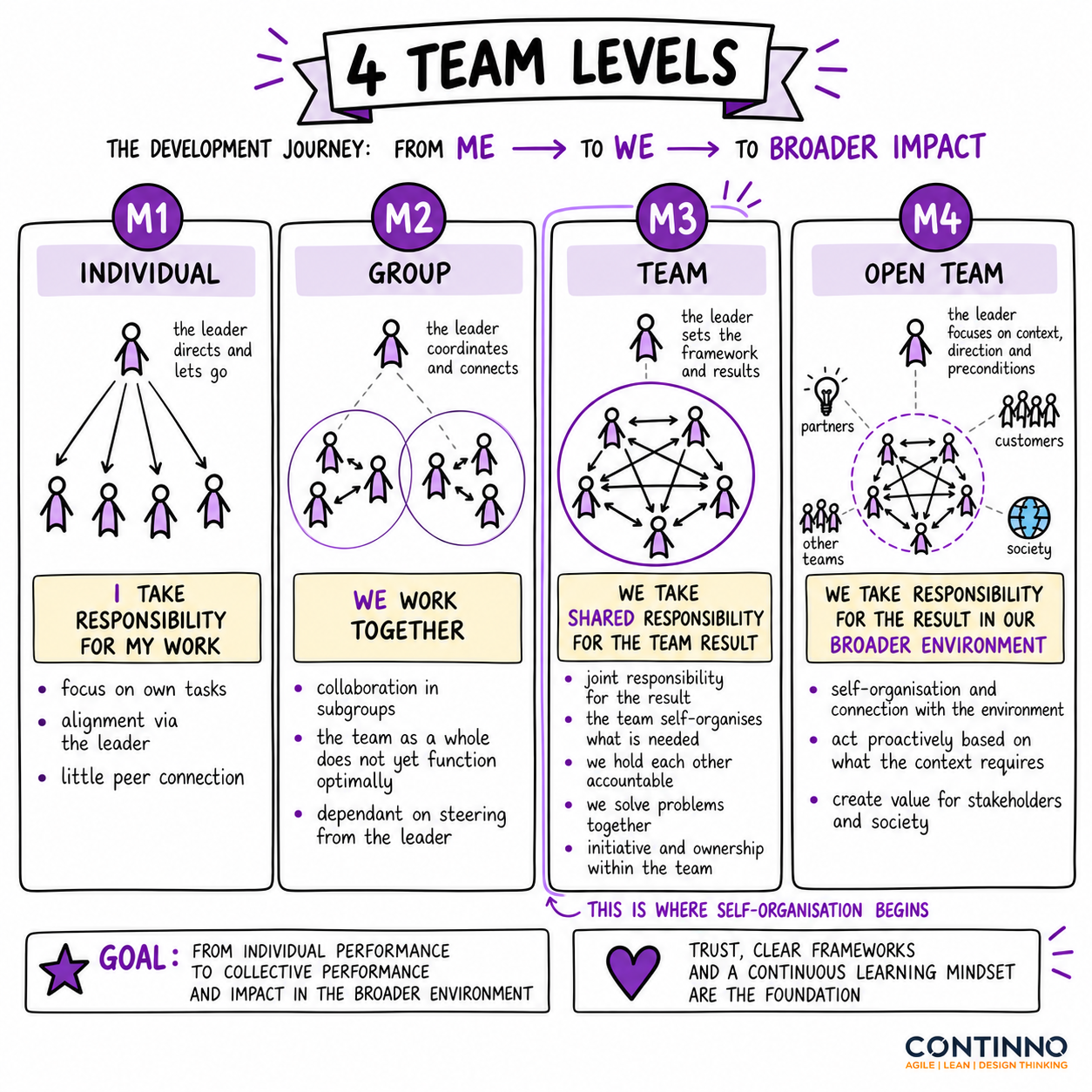
Self-organisation is not something a team either has or doesn’t have. Teams develop through different stages, gradually taking more responsibility for how they work and the results they achieve.
Take a look at the illustration. Which stage best describes how your team works today?
M1 – Individual
People mainly focus on their own work. Coordination happens through the leader, who provides direction and solves many of the issues that arise.
M2 – Group
People work together more, often in smaller groups. There is more collaboration, but the team still depends on the leader to coordinate, connect and keep things moving.
M3 – Team
Responsibility shifts to the team. People organise the work together, solve problems, hold each other accountable and take shared ownership of the team result. This is where real self-organisation starts.
M4 – Open Team
The team looks beyond its own boundaries. It adapts to what the wider organisation, customers and other stakeholders need and takes responsibility for its impact on the broader environment.
The goal isn’t necessarily to reach M4 as quickly as possible. The useful question is: where are you today, what does your context require, and what would help you take the next step?
Sometimes that next step doesn’t require a big transformation programme. A focused team session can be enough to make clear where you stand, what is getting in the way and what to work on next.
More about how I help teams with this: Stronger Teams at Continno
About the author
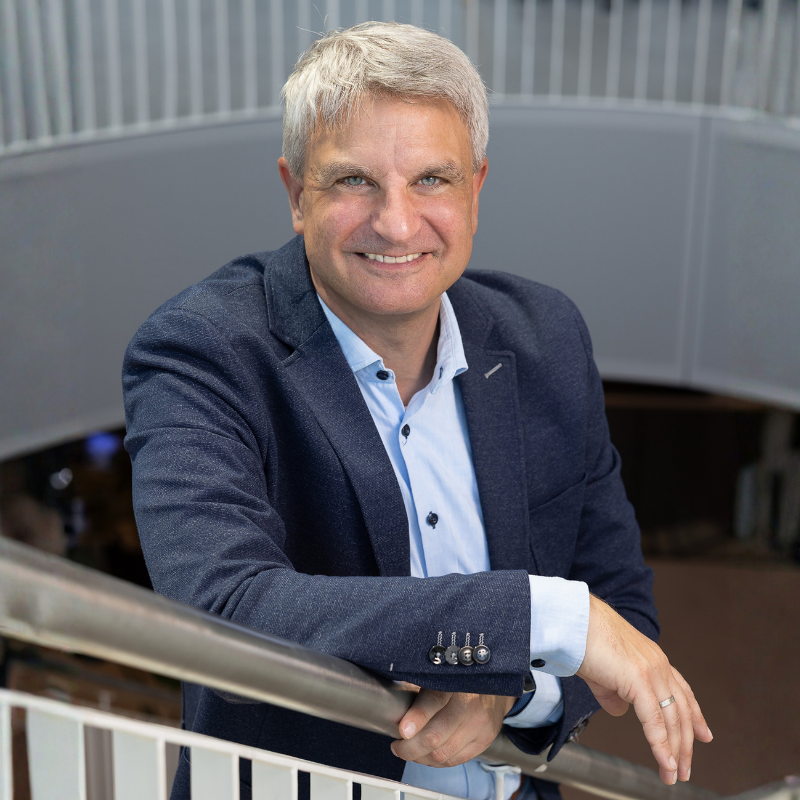
Jens Broetzmann is the founder of Continno and has more than 25 years of experience helping organisations and teams turn change into practical progress. He combines systems thinking, Agile, Lean, Design Thinking and behavioural change principles to create approaches that fit the context rather than forcing a methodology.
Let’s talk about what’s next.
You know where you want to go.
Let’s figure it out together how to get there.
+ 31 – 6 53432423
jens.broetzmann@continno.com
‘s-Hertogenbosch
Get it clear
We discuss what’s getting in the way.
Get it moving
We explore options that could make the biggest difference.
Get it done
You leave with a practical next step.